
Roadshows will be held in Singapore, Hong Kong, London, New York and Boston, NTPC gained close to 1%.

What does one deduce from this silence? That the minorities in the BJP era have been muted, perhaps even coercively, asks Sajad Ahmad Dar.

Markets end higher ahead of Fed outcome, China stimulus

Apple relies heavily on the sale of its flagship iPhones

Till date, 107 elections to states and three parliamentary polls have been smoothly conducted using the EVMs.

The possibility of a deal between Iran and the world on its nuclear programme has some perils but much promise for India, says Uday Abhyankar

IMF attributes the slower growth rate to supply-side bottlenecks.

Many macroeconomic forecasters have built predictive models on inflation, all of which highlight intense downward pressure on prices.

A K Bhattacharya digs into the yet-to-be-public report on ways to curb black money and finds out that Modi's next moves could include action on dabba trading, hawala, and education.
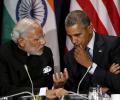
'Big countries do not agree on every set of issues.' 'Look, one of the differences in the relationship is that when we do not agree, we are sitting down and talking to each other.'

Cashi Crisis: Day 9: Aaj ki Taaza Khabar!

'There has definitely been a breakthrough in the nuclear logjam. It is good to see nuclear energy back on the rails,' says Dr Anil Kakodkar, former chairman, Atomic Energy Commission.

The official twists and turns have raised questions on the government's credibility and its ability to pull the nation out of the demonetisation quagmire. To keep up with the new rules, the government has issued an updated FAQ on demonetisation.

The following is the full text of US President Donald Trump's first address to a joint session of the Congress on February 28, as prepared for delivery and released by the White House press office.

'Consider this image of today's youth in Bihar -- armed with a bike, a smartphone and possibly some illegal arms too, imbibing incessant stream of images from the Internet and television.' 'Some of them would turn into gau bhakts, some would listen with interest the exploits of Salafism, dig deep into the Internet to come out with images which cry vociferously that their respective religions are in danger.'

The AAP has adopted policies in an ad hoc manner, without thinking them through or deriving them from a broader framework. This must change if the AAP is to become a credible alternative, says Praful Bidwai.
